
Web 3
Ethereum just solved a critical problem Bitcoin doesn’t want to fix on its own network


Credit : cryptoslate.com
A couple of years in the past, the best solution to clarify Bitcoin to a newcomer was to maintain it easy, sluggish, and durable.
Ten-minute blocks. Restricted area. Everybody checks every part. No one will get particular therapy.
That design is a characteristic. It’s what makes Bitcoin really feel like bedrock.
It is usually why each bull market finally ends up replaying the identical argument. Block area will get tight, charges bounce, customers complain, and builders promise options that reside someplace above the bottom layer.
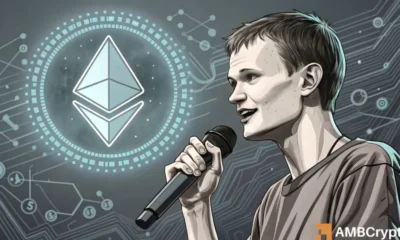
This week, Vitalik Buterin confirmed up with a really completely different declare about Ethereum’s future, one which lands straight on Bitcoin’s turf.
In a publish on X, he argued the blockchain “trilemma” is solved by pairing PeerDAS on mainnet with zkEVMs reaching “alpha” efficiency, whereas safety work continues.
He sketched a 2026–2030 path the place proofs more and more exchange re-execution as the way in which Ethereum validates blocks.
He additionally pointed to a 3rd pillar: extra distributed block constructing over time, so transaction inclusion is tougher for a small membership of builders to seize.

For those who principally reside in Bitcoin land, it’s tempting to shrug. Ethereum all the time has a roadmap, all the time has a brand new acronym, and Bitcoin retains doing what it does.
This one deserves a better look. It’s much less about one other improve and extra about shifting what a “decentralized community” can do, not less than in principle, with code already transport.
The half that’s actual right this moment
Ethereum’s Fusaka upgrade activated on Dec. 3, 2025, at a selected mainnet slot. The Ethereum Basis printed the precise slot timing, and the headline characteristic was PeerDAS.
PeerDAS is a kind of concepts that sounds summary till you scale back it to a single query.
When a rollup posts knowledge to Ethereum, how do we all know that knowledge is definitely obtainable to the community with out requiring each node to obtain each byte?
PeerDAS solutions with sampling.
Nodes subscribe to a small slice of the blob knowledge. They examine sufficient random items that the community will get a high-confidence assure the entire thing is there.
The mathematics behind it makes use of erasure coding, so lacking items will be reconstructed if sufficient of the complete set exists.
The plain-English level is that Ethereum is attempting to boost throughput whereas holding the “common node” workload from exploding.
Ethereum.org’s personal rationalization says a default node receives roughly one-eighth of the unique blob knowledge underneath PeerDAS, as a result of it listens to eight of 128 subnets, and blobs are prolonged for sampling.
That issues as a result of bandwidth is likely one of the quiet killers of decentralization.
When the price of staying synced climbs, residence operators drop off. The community can look distributed whereas behaving like a handful {of professional} operators.
Fusaka additionally launched one thing that feels small however can turn out to be enormous over time: blob parameter-only forks.
These are preprogrammed mini-upgrades that alter blob targets and maximums with out the complete drama of a conventional exhausting fork.
The thought is to let Ethereum raise blob capacity in steps because the community proves it could possibly deal with it.
The Ethereum Basis printed a schedule the place BPO1 raised the blob goal and max to 10 and 15 on Dec. 9, 2025. BPO2 is ready to boost the goal and max once more to 14 and 21 on Jan. 7, 2026.
Coin Metrics framed this as the beginning of Ethereum treating blob throughput like a dial it could possibly flip.
The report additionally notes that blobs had been operating close to the prior six-blob goal and that blob charges usually sat at 1 wei, a well mannered means of claiming the market was barely charging for the useful resource.
That “barely charging” issue is why one other EIP retains exhibiting up within the background.
It units a reserve worth so blob base charges don’t collapse to close zero relative to execution prices.
If you’re a Bitcoiner, this could already sound acquainted.
Block area in Bitcoin is pricey as a result of it’s scarce, and shortage is the purpose. Ethereum is attempting to develop blob area for rollups with out turning it right into a free lunch that invitations spam and centralizes validation.

The zkEVM piece: quick sufficient now, secure sufficient later
PeerDAS is reside right this moment. The zkEVM declare is about what occurs subsequent.
In December, the Ethereum Basis published a second “Delivery an L1 zkEVM” replace that’s blunt in regards to the shift in priorities: pace is now not the primary query. Provable safety is.
The Basis laid out milestones by means of 2026. That features a goal of 100-bit provable safety by the top of Could 2026 and 128-bit by the top of 2026, together with proof-size caps.
Right here is why that issues for Bitcoin.
Bitcoin’s base-layer safety story is easy sufficient to clarify at a dinner desk. Miners hash, nodes confirm, invalid blocks get rejected, and the community strikes on.
Ethereum’s story is trending towards a world the place the community can settle for much more exercise as a result of validators confirm succinct proofs as an alternative of replaying each step of execution themselves.
That may be a completely different form of belief. It’s nonetheless decentralized within the sense that anybody can confirm, but it surely leans extra on cryptography, implementation correctness, and the economics of who produces proofs.
And it comes with a timeline.
Vitalik’s publish sketches 2026 because the 12 months of massive gas-limit will increase pushed by different upgrades, and the primary actual possibilities to run a zkEVM node.
He frames 2027–2030 because the window the place zkEVM validation turns into the first path for block validation.
Why Bitcoin ought to care, even when nothing modifications on Bitcoin
Bitcoin doesn’t have to “win” throughput. It must hold successful credibility.
For a very long time, Bitcoin’s strongest aggressive edge has been decentralization plus a base layer that stays comprehensible, conservative, and brutally exhausting to alter.
Ethereum’s edge has been flexibility and a willingness to scale by means of new primitives, then lean on rollups to hold most person exercise.
These roads are actually colliding.

If Ethereum can scale knowledge availability whereas holding node necessities bounded, and push proof-based validation with out breaking belief assumptions, the market will get a second credible “settlement-style” community.
It will be capable to deal with high-bandwidth exercise with out trying like a permissioned knowledge middle.
That impacts Bitcoin in 3 ways.
First, the narrative premium on block area.
Bitcoin charges spike when demand spikes. That’s regular, and it’s the market sign.
Ethereum is attempting to make the rollup price expertise really feel extra just like the web: regular, low-cost, and boring, by increasing blob capability and smoothing the price market.
If Ethereum succeeds, Bitcoin’s block area stays premium. However the use circumstances that demand premium settlement could slim towards high-value transfers, long-term custody strikes, and settlement of layered techniques.
Second, the battle over decentralized rails for every part else.
A whole lot of crypto’s “actual world” pitch, tokenized {dollars}, on-chain fairness, supply-chain settlement, lives or dies on price and throughput.
Base’s scaling write-up says its median charges fell from about $0.30 to fractions of a cent throughout frequent capability will increase. It additionally factors to Ethereum’s knowledge availability roadmap, together with PeerDAS and additional blob will increase, as the following unlock.
When that form of person expertise exists at scale, capital and builders comply with. Bitcoin’s position turns into extra clearly financial and fewer general-purpose.
Some Bitcoiners will name {that a} win. Others will see it as Ethereum absorbing the components of crypto that entice mainstream customers.
Third, a brand new centralization battleground that Bitcoin already understands.
Bitcoin’s dangers focus in mining swimming pools, ASIC provide chains, and regulation touching custodians and huge intermediaries.

Ethereum’s subsequent dangers focus in prover markets and block constructing, which Vitalik acknowledged by speaking about distributed block constructing and mechanisms like inclusion lists.
On the Ethereum roadmap, the instruments that present up right here embody enshrined proposer-builder separation, fork-choice-enforced inclusion lists, and block-level entry lists. The purpose is to maintain scaling from handing management to a small set {of professional} actors.
Bitcoiners have seen this film.
Scaling usually shifts energy someplace else. The toughest half is holding the system impartial when the tooling will get costly.
What the following 4 years might appear like
No one will get to declare victory in crypto and not using a few “if” statements, and Ethereum’s personal sources are clear that zkEVM security remains to be the primary work.
So the sincere solution to cowl that is with eventualities. The influence on Bitcoin modifications relying on which path performs out.
State of affairs one: sluggish and cautious, fewer surprises. PeerDAS retains increasing blob capability by means of scheduled parameter forks. zkEVM safety milestones take time, and proof-based validation stays elective longer than fanatics need.
On this world, Ethereum improves the price expertise for rollups. The market regularly treats ETH as essentially the most scalable “credible impartial” settlement community exterior Bitcoin.
Bitcoin stays essentially the most conservative financial base. The aggressive pressure stays ideological and investor-driven.
State of affairs two: demand pulls the roadmap ahead. Rollups take in blob capability rapidly, utilization stays excessive after every BPO step, and Ethereum retains turning the dial upward.
On this world, the “low-cost crypto UX” narrative consolidates round Ethereum’s rollup stack. Bitcoin turns into much more clearly a settlement and financial savings layer.
The market begins asking whether or not Bitcoin’s L2 ecosystem can provide an identical expertise whereas retaining Bitcoin’s social and technical conservatism.
State of affairs three: zk proofs turn out to be regular, and the argument modifications. Ethereum hits its safety targets, proof verification turns into the default for validators, and better fuel limits turn out to be extra possible with out elevating {hardware} necessities for everybody.
On this world, Ethereum’s declare to “high-bandwidth decentralization” turns into tougher to dismiss. Bitcoin’s differentiation leans tougher on simplicity, immutability, and financial coverage.
The investor dialog shifts towards two base layers with completely different philosophies, somewhat than one base layer and a crowd of alt chains racing for pace.

What customers really really feel
Most customers don’t get up enthusiastic about knowledge availability sampling.
They get up annoyed that shifting cash prices an excessive amount of, or {that a} swap fails, or {that a} memecoin mint chews up a paycheck in charges.
Bitcoiners know this ache too, particularly when the mempool will get crowded, and charges worth out informal customers.
Ethereum’s promise here’s a future the place the bottom layer stays decentralized sufficient for unusual validators, whereas the person expertise occurs on rollups with prices that really feel like app charges, not settlement charges.
If that occurs, it doesn’t kill Bitcoin. It clarifies Bitcoin.
Bitcoin turns into the factor you belief if you wish to exit the on line casino.
Ethereum turns into the community that tries to make the on line casino scale with out collapsing right into a single operator.
The chance is that Ethereum’s path requires extra shifting components, extra cryptography, extra subtle markets for constructing and proving blocks, and extra possibilities for focus to sneak in by means of the again door.
Vitalik all however says so when he highlights distributed block constructing as unfinished enterprise.
Bitcoin’s danger is completely different. It stays sluggish, it stays scarce, and it stays costly when demand rises.
The trade retains attempting to rebuild the world on layers above it.
Backside line
Vitalik’s “trilemma solved” line is a headline. The substance is a roadmap, with actual code already deployed on the information facet and a tough safety push on the proof facet.
Bitcoin ought to care as a result of the strongest argument for Bitcoin as crypto’s solely credibly impartial base layer weakens if Ethereum can scale with out pricing out common validators.
Bitcoin also needs to keep calm. Bitcoin’s worth proposition shouldn’t be throughput.
It’s restraint, predictability, and a base layer that continues to be legible underneath stress.
The extra Ethereum evolves towards a high-bandwidth settlement material, the extra Bitcoin’s position because the conservative financial anchor appears intentional somewhat than outdated.
That’s the form of competitors crypto wants: two networks pushing completely different definitions of belief, and forcing the remainder of the market to cease complicated pace with decentralization.








Why Wyoming’s $FRNT matters now

RollerCoin Named Game of the Year and Best Browser Game at the 2025 Blockchain Game Awards

Polymarket seems riddled with insider trading yet a massive Dow Jones partnership just validated prediction markets

‘The Biggest AltSeason Will Start Next Week’ -Will Altcoins Outperform Bitcoin?

Orbler Partners with Meta Lion to Accelerate Web3 Growth

DOGE Sees Massive User Growth: Active Addresses Up 400%

TRON! 10X UNSTOPPABLE ALTCOIN JUGGERNAUGHT OUTPERFORMING BETTER THAN ALL BIG ALTCOINS! WHY NOW

THE NO.1 ASSET TO INVEST IN IS YOURSELF – BEST CRYPTO EDUCATION RESOURCES & DISCORD GROUP 2026

Bitcoin Holds Firm, Zcash Rebounds, Big Crypto Developments Ahead & More!


Crypto index ETFs emerge as investors seek simplicity
Credit : cryptoslate.com US spot crypto ETFs have attracted internet inflows of greater than $70 billion since January 2024, making...


Solana ends Saga phone support, exposing owners to a critical wallet risk you can’t ignore
Credit : cryptoslate.com Solana Cellular has stopped supporting software program updates and safety patches for its Saga smartphone. The corporate...


Bitcoiners waiting for a “Bukele moment” in Chile are ignoring a $229 billion signal that matters more
Credit : cryptoslate.com Chile has taken a tough flip. In a decisive runoff on December 14, José Antonio Kast, a...


The 12 crypto winners of 2025
Credit : cryptoslate.com If 2024 was the 12 months of the crypto reawakening, 2025 was the 12 months the plumbing...


The great rewiring of global finance
Credit : cryptoslate.com 2025 delivered a brutal lesson in market construction for Bitcoin. The 12 months started with political momentum...


10 stories that rewired digital finance in 2025
Credit : cryptoslate.com This 12 months opened with Bitcoin (BTC) proponents anticipating a clear rally, pushed by halving narratives, spot...


How Strategy cornered the Bitcoin market but lost the equity war
Credit : cryptoslate.com In 2025, Technique (previously MicroStrategy) pulled off a feat within the capital markets that successfully cornered the...

Bitcoin finds a new home inside America’s largest banks
Credit : cryptoslate.com For years, US banks handled Bitcoin as one thing finest noticed from a distance. The asset lived...
-
 Analysis4 months ago
‘The Biggest AltSeason Will Start Next Week’ -Will Altcoins Outperform Bitcoin?
-
 Blockchain1 year ago
Orbler Partners with Meta Lion to Accelerate Web3 Growth
-
 Meme Coin10 months ago
DOGE Sees Massive User Growth: Active Addresses Up 400%
-

 Videos1 year ago
Shocking Truth About TRON! TRX Crypto Review & Price Predictions!
-

 NFT1 year ago
SEND Arcade launches NFT entry pass for Squad Game Season 2, inspired by Squid Game
-

 Web 34 months ago
HGX H200 Inference Server: Maximum power for your AI & LLM applications with MM International
-

 Meme Coin1 year ago
Crypto Whale Buys the Dip: Accumulates PEPE and ETH
-

 Videos6 months ago
Stack Sats by Gaming: 7 Free Bitcoin Apps You Can Download Now


